
Sentry Lift UHMWPE Web Slings
Sentry Lift® Cut-Resistant and Abrasion-Resistant Sling Webbing
Sentry Lift® is UHMWPE-based (Ultra-High Molecular Weight Polyethylene) sling webbing product line made from the same material used in body armor, mooring lines, helicopter longlines as well as Roundslings that have shaped the heavy lift industry for over 40 years. Tested under ASTM D6770 and EN388 standards, Sentry Lift® provides approximately 24x more abrasion resistance and 7.6x more cut resistance than conventional polyester and nylon lifting slings.
Engineers, safety professionals and buyers will find what they need here to specify the right sling for the job. Looking for a cut-proof sling? This page will tell you why that product doesn't exist — and what the facts really mean when it comes to cut resistance.
| SENTRY LIFT® AT A GLANCE | |
|---|---|
| Abrasion Resistance | ~24× superior abrasion performance than standard polyester/nylon (ASTM D6770 Performance Index) |
| Cut Resistance | ~7.6× more cut-resistant than Class 5 polyester — EN388 Coup Test, 5-trial average: 345.62 vs 45.72 cycles |
| Tensile Strength | Over 15,000 lb per inch — approximately twice standard webbing |
| Stretch Under Load | 60–80% less than conventional polyester or nylon (Less than 1% elongation) |
| Operating Temperature | −40°F (−40°C) to 140°F (60°C) |
| Standards | ASTM D6770 (abrasion); EN388 (cut); ASME B30.9 (compliance); WSTDA TM1 (tensile strength) |
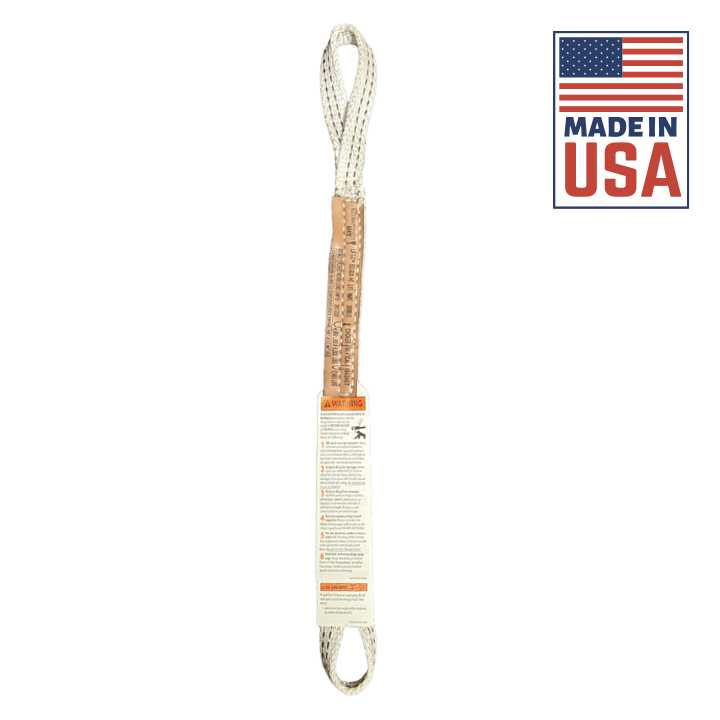
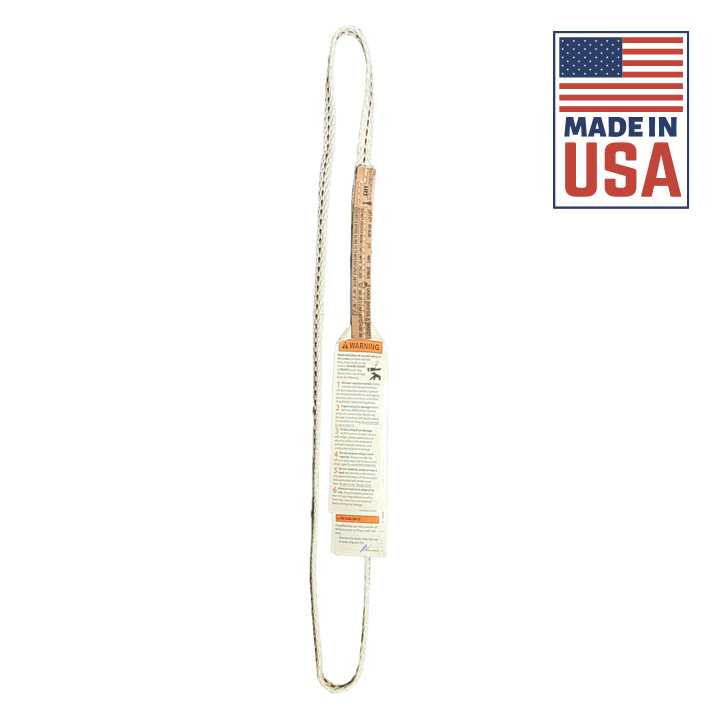
Eye & Eye SlingsSHOP NOW | Endless SlingsSHOP NOW |
|
|
Why Do Synthetic Slings Fail?
Synthetic web lifting slings most commonly fail due to cuts, abrasion and UV degradation. In fact, over 75% of Lift-It Manufacturing’s product liability claims involving synthetic slings have been related to cuts. Not aged, worn out, or overloaded slings. And often, they’re small cuts. That's what makes this failure mode so difficult to manage.
Because this type of damage can easily go unnoticed to untrained eyes that lack qualifications and/or do not perform per-use or periodic inspections. Cut lifting slings may look just fine until they fail, and fail hard.
To demonstrate this, we took 4 brand new single-ply slings, 3” wide from the same roll of 9800 lb/in sling webbing (same thread count, same machine, same sewing machine operator) and ran them all to breaking point. We kept one pristine. The other three we cut at the edge with varying dimensions to mimic realistic damage.
Here’s what happened:
- The undamaged control broke at 26,050 lb.
- 1/8-inch cut: 22,150 lb — down 15%
- 1/4-inch cut: 18,090 lb — down 31%
- 3/8-inch cut: 15,480 lb — down 41%. Only 59% of rated capacity remaining.
These results show that even the smallest of cuts reduces the load capacity considerably and if overlooked results in injury, death and property damage.
Abrasion works on a slower time scale, but the damage is just as impactful as cutting. Abrasion leads to loss of fiber which decreases overall strength over time.
What Makes Sentry Lift® an Ultra Abrasion-Resistant and Cut-Resistant Sling?
Sentry Lift® is manufactured by OTEX from UHMWPE (Ultra High Molecular Weight Polyethylene), also known in the industry as HMPE (High Modulus Polyethylene). It outperforms polyester and nylon by approximately 24x in abrasion resistance, 7.6x in cut resistance, has 60-80% less stretch when under load and tensile strength ratings over 15,000 lb per inch!
Think of UHMWPE's molecular composition as being structured a bit like chainmail. One ring isn’t going to stop a blade, but the overlapping structure transfers force throughout the surface. Regular polyester strands absorb that force and snap. UHMWPE links distribute it.
It’s what makes UHMWPE suitable for ballistic panels, and it’s also why you see such a huge difference between Sentry Lift® and traditional webbing in our testing data.
It holds up chemically, too. Water, oil, UV, most industrial chemicals — UHMWPE isn't affected the way standard webbing is. In marine environments or anywhere with significant chemical exposure, you can expect a longer sling life than polyester or nylon sling webbing.
Because UHMWPE thread is stronger, splices run much shorter — and still carry the full strength of the webbing at the load carrying splice. Threads must match the chemical composition of the webbing and therefore UHMWPE thread is used in conjunction with Sentry®.
Is this product cut-proof?
There is no such thing as a cut-proof sling. Enough tension and compression, especially when combined with movement, can part anything. Sentry Lift® raises the bar but doesn’t eliminate the need for disciplined rigging practices. Lack of load control (such as occurs when a sling moves across a load edge while under tension) can cut through any sleeve or sling material, no matter how strong or expensive.
| KEY TERMS | |
|---|---|
| UHMWPE | Ultra-High Molecular Weight Polyethylene - a high strength synthetic fiber commonly used in ballistic protection, medical implants and industrial textiles alike, Sentry Lift® webbing included. |
| WLL (Work Load Limit) | The maximum load that may be applied, including any increased tension due to rigging geometry, when rigged in a particular configuration. Vertical, choker and basket each have different WLL values. |
| Abrasion Resistance | Ability of a material to withstand surface wear caused by frictional movement between two materials or objects. Standardized by ASTM D6770 and rated in cycles to failure. |
| Cut Resistance | Ability of a material to withstand cutting force, especially while under load. Standardized by EN388 Coup Test and rated in cutting cycles until penetration. |
| Performance Index | Rating that determines a material's abrasion performance: cycles × remaining strength ratio. Sentry Lift® boasts a rating of 9,000 while standard polyester tests at 380 - nearly 24× higher. |
| Tensile Strength | The maximum amount of linear force sling webbing can support prior to failure of the material. Sentry Lift® HMPE webbing has a tensile strength of over 15,000 lb per inch. That's about twice that of regular Nylon-Poly slings. |
| Choker Hitch | A rigging method where the sling loops around the load, producing the lowest WLL of the three standard hitch types. Loss-factor testing is required for UHMWPE slings before use in this configuration. |
| OSHA (DOL / CFR) | Enforceable regulations governing slings and material handling. |
| ASME B30.9 | The recommended standard addressing sling use and care referenced as industry best practice throughout North America. Covers proper use, inspection requirements and retirement specifications that either complement or expand on OSHA 1910.187 and 1926.251. |
| WSTDA | Web Sling and Tie Down Association. Responsible for the publishing of WS-1 (web slings), TH-1 (thread) and TM-1 (strength testing). These publications provide more detailed construction, inspection and use specifications for web slings. |
What Did ASTM D6770 and EN388 Testing Actually Show?
We tested Sentry Lift® head-to-head against Class 5 polyester sling webbing in the two most common industry tests – ASTM D6770 abrasion testing (aka Hex Bar) and EN388 cut testing. The Sentry Lift® UHMWPE lifting sling won by an overwhelming margin.
How is abrasion resistance measured — and what did ASTM D6770 find?
Load-edge contact is replicated in the tests listed under ASTM D6770 by dragging webbing loaded to multiple heights across a hex rod back and forth. The result of the test is noted as the number of cycles to failure. But this number alone isn’t very meaningful.
One sling might last more cycles than another, but if it loses most of its strength along the way, it actually becomes hazardous – because it fails with little warning.
That’s why we track results using the Performance Index ratio. By multiplying cycles to failure by the percentage of break strength remaining, we arrive at a single number that represents not just how long a material will last but how much strength it retains while still in service.
After 1,000 cycles, standard polyester had 38% strength remaining, for a Performance Index of 380. Sentry Lift® UHMWPE had 12,000 cycles to failure and retained 75% of its break strength – a Performance Index of 9,000. That’s 24 times better than polyester sling web!
How is cut resistance tested — and what did EN388 show?
The test specified by EN388 runs a rotating blade across the fabric under a fixed load and counts the cycles before it cuts through. Five trials were run on each material:
| Trial | Class 5 Polyester (cycles) | Sentry Lift® (cycles) |
|---|---|---|
| 1 | 45.8 | 347.9 |
| 2 | 20.1 | 518.8 |
| 3 | 53.5 | 326.3 |
| 4 | 51.6 | 204.5 |
| 5 | 57.6 | 330.6 |
| Average | 45.72 | 345.62 (7.56× greater cut resistance) |
The results show that Sentry Lift® lifting slings achieved an average cut resistance of just over seven and a half times greater over the five trials, a phenomenal cut resistance score.
Work Load Limits, Configurations, and Temperature Ratings
Sentry Lift® sling webbing systems are manufactured in Eye & Eye (EE) and Endless (EN) configurations, in both 1 through 4 ply, and with web widths ranging from 1/2 inch through 4 inches. Lift-It Manufacturing has established WLL values based on destruction testing using WSTDA specified pin diameters.
Temperature limits: 140°F (60°C) maximum, −40°F (−40°C) minimum
Consider the entire thermal environment and be aware of ALL heat sources, such as ambient heat, reflected heat, frictional heat (including frictional heat that may develop during the load handling activities – especially in a choke hitch), open flames, hot surfaces from welding, grinding or heat treating, even if they're not directly touching the sling.
What are the Limitations of Sentry Lift® Lifting Slings?
Typically, Sentry Lift® will afford you 24x the abrasion resistance and 7.6x the cut resistance compared to traditional polyester or nylon webbing. It’s a big leap forward, but no sling removes all risk by itself.
Responsibilities that remain unchanged, regardless of the sling used, include:
Keep all personnel clear of suspended loads at all times.
Inspect load geometry. A qualified person at every lift must inspect all sling to load contact points, determine if the edge radius is acceptable and verify the sling will maintain positive sling to load engagement throughout the lift.
Perform test lifts. This is one of the most underrated practices and should be utilized frequently. Lift the load off the ground just enough to clear, verify the sling to load contact is at the predicted locations and that the slings cannot move along the load edge, then lower and inspect the sling and any protection devices before continuing. More than one test lift may be necessary. Test or practice lifts allow the qualified person to make an assessment regarding sling protection, tension factors that drive load calculator, center of gravity and share of load if more than one sling is being used. Remember that while Sentry Lift provides inherent abrasion and cut resistance, that does not omit the responsibility of the qualified person to protect any/all slings from edges with a material of sufficient strength, thickness and contusion to prevent damage.
Temperature extremes. Do not use your Sentry Lift® slings over 140°F (60°C) or under -40°F (-40°C). Be mindful of surface temperatures as well as frictional heat that will occur during the lift, not just the ambient temperature.
Inspection is critical. ALL THREE LEVELS of inspection as discussed in ASME B30.9 must be conducted - Initial, Frequent, and Periodic. Refer to removal from service criteria listed in ASME B30.9-5.9.5 and if any removal criteria conditions exist that cause doubt as to the continued use of the product remove from service immediately and consult the manufacturer or qualified persons.
Do Sentry Lift® Web Slings Still Require Protection?
ASME B30.9-2025 requires that all synthetic slings shall be protected from damage caused by edges, corners, protrusions, and abrasive surfaces. That applies to EVERY synthetic sling in use today, no matter what the webbing material or performance rating may be.
Think about why the standard exists. A sling, regardless of material or construction, can be cut, abraded, or torn when tension and compression occur between the sling, connection points, and load. Sentry Lift® is a high wear-tolerance sling that provides a greater margin of performance before failure – it does not mean failure cannot happen!
Built-in webbing strength is just one layer of protection. Engineered protection devices, proper rigging geometry, and disciplined load control all are critical components that must be assessed when performing any lifting function.
Selecting the correct protection devices
Not all abrasion or cut protection materials are created equal – and the difference between abrasion protection and cut protection is very important. Technologies and designs used to address abrasion hazards often work differently from those used for cutting.
A material that works well for friction may provide no protection against direct cutting force.
Never use improvised protection. Cardboard, work gloves, firehose, vehicle tires and other makeshift materials were never designed for use as sling protection and have no pedigree of engineering for sling protection.
Inspect sling protection before each lift
Protection devices should be installed and inspected for suitability before the load is lifted and evaluated during test lift(s). After each lift, remove the slings and protection devices and inspect them carefully. Sling protection must be inspected in the same fashion as slings. We do not use damaged slings and likewise cannot use damaged sling protection.
Make sure the sling protection being used is the correct type and size for the sling, and ensure that the length of any sleeve or other protection material will stay fully engaged during the lifting function.
Which Industries and Applications Need a Cut-Resistant or Abrasion-Resistant Sling?
Ask yourself one question: are you lifting something with edges, weld seams, cast flanges, rough concrete surfaces or abrasive coatings? If the answer is yes, normal webbing will wear out – and likely fail.
Typical industrial applications for specifying a Sentry Lift® extreme duty sling include:
Structural steel fabrication and erection. Weld beads, formed edges, mill scale. High-load, repeat contact. ASME B30.9 likely had this application in mind when they removed the word “sharp” from the standard.
Heavy manufacturing and machining. Cast and machined surfaces impose immense cutting forces at the edge radius where the edge meets tension.
Shipbuilding and marine construction. Salt water and UV degradation. Normal webbing degrades from exposure to both salt and sunlight; Ultra-High Molecular Weight Polyethylene resists.
Precast concrete. A constantly abrasive material. And you’ll probably use the same lift path hundreds of times. At that volume, exceptional wear resistance isn’t a nice-to-have. It’s cost-effective, besides being safer.
Demolition and scrap handling. Junkyards and demolition sites are full of sharp and inconsistent edges. Normal webbing will wear through quickly when your loads are this severe, requiring frequent replacement. Increased abrasion and cut resistance are a cost saving solution to premature sling retirement.
Government, defense, and aerospace procurement. OTEX Specialty Narrow Fabrics, the manufacturer of Sentry Lift® webbing, has supplied performance textiles for military and aerospace applications for many years, so you will have all the documentation you need.
Mining. Rocks, bulk material handling, with oddly shaped and often heavy loads. In extreme-duty applications like mining, high-grade abrasion resistance isn’t impressive – it’s whether you’re running an efficient sling program or merely reacting to failures by replacing the same failed slings with inferior materials. Select Sentry Lift® slings for a superior and more robust web sling.
How to Specify and Order Sentry Lift® Slings
- Sling Type: Endless (EN) or Eye & Eye (EE)
- Number of plies or sling thickness: 1 (1 Ply) – 2 (2 Ply) – 3 (3 Ply) – 4 (4 Ply)
- Webbing designation & webbing width: Sentry Lift (SL) + 05 (1/2 inch) – 1 (1 inch) – 2 (2 inch)
- Eye configuration for EE slings: FE (Flat Eye, no taper) – FT (Flat Eye, Tapered*) – HT (Half Twist, no taper) – HTT (Half Twist, Tapered*)
*Tapered eyes are only available for 2 inch wide slings - Length: Determine the length you need above the required minimum length per sling type as noted in the charts.
- Example: EE2-SL02-HTT X 4 Ft = Eye & Eye configuration, 2-ply, 2-inch sling. Contact your sales representative for a reference chart, data sheets or quote.
Frequently Asked Questions
What is a cut-resistant sling?
Constructed from a synthetic webbing designed to better withstand contact with edges. Cut Resistance is rated using the EN388 Coup Test — rating achieved is cycles endured before blade penetrates under standardized load. Sentry Lift® averaged 345.62 cycles vs. Class 5 Polyester’s average of 45.72. That’s right… 7.56×
What's the difference between cut-resistant and abrasion-resistant?
Cut Resistance refers to concentrated edge force applied to one point. Abrasion Resistance refers to wear caused by scuffing, rubbing and/or elongating over a surface. While they are related, they are different material properties. Excelling in one doesn't necessarily mean the material will excel in another. Sentry Lift® excels at both. Approximately 24× more abrasion resistant and 7.56× more cut resistant than standard Class 5 Polyester.
Can you get a fully cut-proof sling?
No. Any advertising to the contrary is either an outright lie or a claim that no responsible rigging supplier would make and that no standard endorses. Even if you had a fully edge-protected sling, poor control and/or other various factors can result in failure. The sling is one piece of the puzzle, it's not a fail-proof method allowing improper rigging techniques. Riggers must always protect against damage to slings.
What standard governs synthetic sling protection?
The main standard for synthetic web slings in North America is OSHA 1910.184 & 1926.251. Additionally, riggers must be aware of ASME B30.9. The 2025 edition of the standard specifically states “shall be protected from damage” for all synthetic slings used. Sling protection is mandatory, not a suggestion. WSTDA’s WS-1 covering Construction and Safe Use of Synthetics Standards also complement it nicely.
How much stronger is Sentry Lift® than regular polyester slings?
Unsewn tensile strength exceeds 15,000 lb per inch — roughly twice standard polyester. A 2-ply, 2-inch Eye & Eye (EE2-SL02) carries a basket WLL of 22,000 lb. A 4-ply, 2-inch Endless (EN4-SL02) hits 84,000 lb in basket configuration.
What environmental temperatures can Sentry Lift® withstand?
Heat: 140°F (60°C) / Cold: -40°F (-40°C). On top of ambient temperatures being within range, make sure the entire environment stays within those ranges. The surrounding air temperature is irrelevant if nearby welding, grinding, or heat-treating operations are causing the sling to be exposed to hazardous temperatures.
When should I retire my Sentry Lift® sling?
If you discover any damage as stipulated in the removal from service criteria — that sling needs to come out of service. Period. For more information, see ASME B30.9, Section 9-5.9.5 as noted earlier.
What is UHMWPE?
Ultra-High Molecular Weight Polyethylene — polymer chains at 3.5 to 7.5 million g/mol. The same fiber used in ballistic panels, mooring lines, helicopter longlines, heavy-lift industrial Roundslings and Twin-Path® slings.
Which industries benefit most from extreme-duty abrasion-resistant slings?
Steel fabrication, utility, heavy industry, shipbuilding, precast concrete, demolition/scrap/recycling, mining, and government/defense/aerospace — anywhere load surfaces are rough or edged and the paperwork has to hold up under scrutiny.
Specification Support and Technical Documentation
Full WLL tables, break-test certificates, ASME B30.9 compliance documentation, and tagging templates are available on request. A complete documentation package formatted for government and defense contract submission is also available.